
Wind Load Requirements for Garage Doors in Collier County
How Florida sets your design wind speed, how that becomes a design pressure in pounds per square foot, what Florida Product Approval really certifies, and how a Naples garage door passes inspection. Written by the people who install and permit them.
📐Design Pressure Explained,🗺️Exposure B / C / D,📄FL# & Miami-Dade NOA,🏛️Collier Permitting,🇺🇸 Locally Owned With 20+ years in the trade

$100 off spring replacement · $150 off opener installation · $700 off a new door · $75 off rollers · $65 hurricane-season maintenance.
Valid Sep 17 – Oct 31, 2026 · Call and mention the code · Cannot be combined
📞 Call (239) 832-1866See all coupons →Wind load requirements are the reason two identical-looking garage doors on the same street can differ by thousands of dollars. Almost nobody explains this to homeowners, so the conversation usually ends at “it’s hurricane rated” — which, on its own, means very little. This page is the long explanation: where the numbers come from, what they mean, and how they turn into a door that passes a Collier County inspection.
We are Speedy Garage Doors Naples. We install, permit and inspect garage doors across Collier County, we are locally owned, licensed LCC20260000672, and we have been doing this here with 20+ years in the trade. Nothing on this page is a substitute for a design professional’s calculation for your specific building — but after reading it you will know exactly what to ask for and what a straight answer sounds like.
The short version
- Florida assigns your address an ultimate design wind speed (Vult), read from a map. In Collier County this generally runs from roughly 150 mph inland to about 172 mph on the coastal strip.
- Your building gets an exposure category (B, C or D) based on the terrain upwind of it.
- Wind speed, exposure, building height, roof geometry, the door’s size and where the door sits on the wall are combined to produce a design pressure in pounds per square foot — a positive number for push and a negative number for suction.
- The garage door you install must carry a Florida Product Approval (an FL number) or a Miami-Dade NOA that covers that size at those pressures.
- Because Collier County sits in the windborne debris region, the opening also needs impact protection — either an impact-rated door, or approved shutters over a wind-load-rated door.
- The approval document specifies the installation detail — anchor type, spacing, embedment, jamb material. The inspector checks that, and the installation is where most real-world failures come from.
Everything below expands on those six points.
Want to know the design pressure for your address?
Send us the address and a photo of your current door. We will tell you what it needs and whether what you have already meets it — no charge.
🔧 Licensed Collier County LCC20260000672
⭐ 4.9 from 336 Google reviews · 🕐 Open 24/7
Request your free estimate
No obligation. No trip charge. We never share your details.
Where the Wind Speed Number Comes From
ASCE 7, risk categories and what “ultimate” means
The Florida Building Code adopts the wind provisions of ASCE 7, the national standard for minimum design loads. Two things about it confuse almost everyone.
“Ultimate” design wind speed is not the same as the old numbers
Older codes used a nominal (allowable stress design) wind speed. Current codes use an ultimate design wind speed, Vult, which is a larger number for the same actual hazard because the safety factor moved from the load side to the strength side of the equation. This is why a homeowner may remember “we’re a 120 mph zone” and now sees 150 or 160 on a map. The building is not suddenly in more danger; the bookkeeping changed. If you are comparing an old document to a new one, make sure you are comparing like with like.
Risk category
Buildings are grouped by the consequence of their failure. An ordinary house is Risk Category II. Schools, assembly buildings and larger occupancies are Category III; hospitals, emergency operations and shelters are Category IV, and they are designed for a rarer, stronger wind. Agricultural buildings and minor structures can be Category I. For a residential garage door in Naples you are almost always working from the Category II map — but if you own a church, a school building or a clinic in Collier County, your door is held to a higher number, and that is a real cost difference.
The map is by address, not by county
Collier County is not one wind speed. The contours run roughly parallel to the coast, so a house on Marco Island, in Port Royal or on Vanderbilt Beach carries a higher Vult than one in Golden Gate Estates or out toward Ave Maria. Collier County publishes wind speed mapping for exactly this purpose, and a permit reviewer will read it against your parcel. This is why any contractor who quotes a “hurricane door” without asking your address is not actually quoting a code-compliant job.
Naples, Marco Island and unincorporated Collier are different jurisdictions
The City of Naples, the City of Marco Island and unincorporated Collier County each run their own building departments. The wind criteria come from the same statewide code, but submittal requirements, fees and inspection scheduling differ. We handle all three regularly; if you are managing your own contractor, know which one you are dealing with before you promise anyone a timeline.
Exposure Categories B, C and D in Collier County
The single most misunderstood input, and the one that changes your price the most
Exposure category describes the roughness of the ground upwind of your building. Rough ground — trees, houses, buildings — slows the wind near the surface. Smooth ground, and especially open water, does not.
Exposure B — urban and suburban, wooded
Terrain with numerous closely spaced obstructions the size of single-family houses or larger, extending a substantial distance upwind. In Collier County this fits mature, built-out subdivisions with grown landscaping — much of Pine Ridge, the Vineyards, older parts of North Naples, established sections of Lely. Lowest pressures of the three.
Exposure C — open terrain with scattered obstructions
Flat open country, grasslands, and areas where obstructions are scattered and under about 30 feet. This is the default when nothing else clearly applies, and it covers a great deal of Collier County: much of Golden Gate Estates, the agricultural fringe toward Immokalee, Ave Maria, Orangetree, and any new subdivision whose landscaping has not matured. Meaningfully higher pressures than B.
Exposure D — flat, unobstructed, facing water
Applies where the building faces open water over a significant upwind distance. On the Collier coast this catches Gulf-front and bay-front property on Marco Island, Vanderbilt Beach, Isles of Capri, parts of Port Royal and homes fronting large open bays. Highest pressures — and it is the reason a waterfront garage door quote can shock people.
Why this is where arguments happen
Exposure is a judgement applied to a specific building, and it is legitimately arguable at the margins — a house three lots back from open water, or a subdivision that was Exposure C when it was built and is arguably B now that the oaks have grown. The practical guidance for a homeowner is simple: do not let anyone quietly choose the cheaper exposure to win your job. If your door is specified to Exposure B and the reviewer decides you are C or D, you fail, you re-order and you pay twice. Ask what exposure the quote assumes and get it in writing.
Height and roof geometry matter too
Mean roof height feeds the velocity pressure coefficient — a two-storey house sees more than a single-storey one — and roof slope and building shape affect the pressure coefficients. For a typical Naples single-storey house with an attached garage this is usually straightforward, but if you have a two-storey home with the garage tucked under living space, or a very low or very steep roof, the numbers move.
Code-Compliant Garage Door Installations Across Collier County
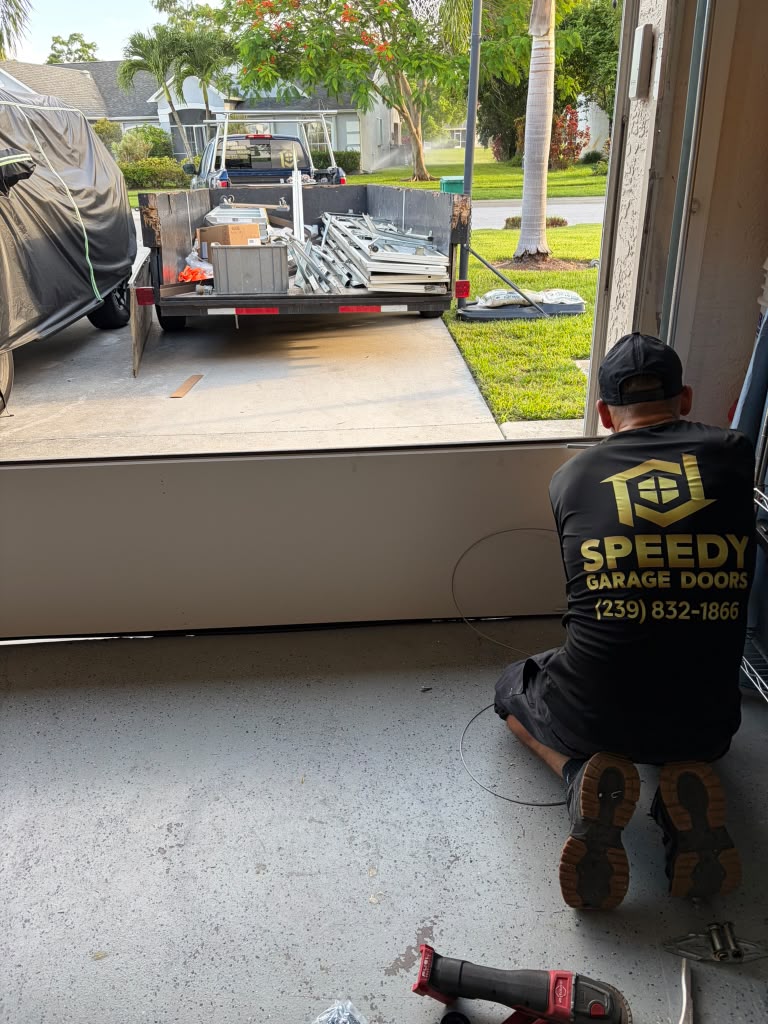
3 photosPermitted, inspected and anchored to the approval detail — Naples, Marco Island, Golden Gate and beyond.


From Wind Speed to Design Pressure
How a mph number becomes pounds per square foot on your door
Your garage door is not designed for a wind speed. It is designed for a pressure. The path from one to the other is roughly this.
Step 1 — velocity pressure
The design wind speed is converted to a velocity pressure (qh) using the exposure-dependent velocity pressure coefficient at your mean roof height, plus factors for topography and directionality. Two buildings with the same Vult but different exposures get different velocity pressures. This is the step where Exposure D punishes waterfront property.
Step 2 — pressure coefficients, and the corner problem
Velocity pressure is then multiplied by external and internal pressure coefficients. For components and cladding — which is what a garage door is — the coefficients depend on where on the wall the component sits. Walls are divided into a field zone (Zone 4) and corner zones (Zone 5). Corner zones see substantially higher suction, because that is where the flow separates.
Practical consequence: a garage door close to the corner of the house needs a higher-rated door than the same door in the middle of a long wall. On many Naples houses, the garage is on the end of the building, which puts a good part of the door in the corner zone.
Step 3 — effective wind area
Larger components are permitted a lower design pressure than small ones, because gusts do not act uniformly across a big surface at the same instant. A 16-foot door therefore gets a slightly gentler coefficient than a small window — but it also has seven times the area, so the total force is still far larger. Do not let the coefficient fool you: bigger is still worse.
Step 4 — internal pressure
The building is classified as enclosed, partially enclosed, or open. An enclosed building has a modest internal pressure coefficient. The moment your garage door fails, the building becomes partially enclosed and the internal pressure coefficient jumps dramatically — which is the code’s own way of saying what we say plainly on our hurricane garage doors page: losing the door changes the loads on your entire roof structure, not just on the opening.
What the answer looks like
The output is a pair of numbers, for example +35.0 / −38.5 psf. Positive is inward push, negative is outward suction. Your door’s approval must cover both, at your size. In Collier County residential work, doors are commonly specified somewhere in the ±30 to ±55 psf range depending on all of the above, with coastal and corner-zone cases running higher.
Why suction usually governs
People picture wind pushing the door in. In practice the negative (suction) number is frequently the larger of the two and is what governs the design. Suction pulls the door outward against its track brackets and end hinges — the connections, not the panel. This is exactly why hurricane doors have more brackets and heavier anchors rather than simply thicker steel, and why testing is cyclic rather than a single push.
Impact Protection: The Windborne Debris Region
Pressure is only half the requirement
Meeting the pressure is not sufficient in Collier County. Coastal Florida is designated a windborne debris region, and in that region glazed openings and garage doors must also be protected against impact — because a door that holds 45 psf beautifully is useless once a roof tile puts a hole in it and the pressure walks straight inside.
The large missile test
The recognised protocol fires a nominal 9-pound 2×4 timber at the specimen at roughly 34 miles per hour (about 50 feet per second), at specified target points. The same specimen then goes into a cyclic pressure rig and is loaded thousands of times, positive and negative, simulating the hours of a passing storm. To pass, the assembly must not be penetrated and must not develop a tear or opening beyond very tight limits.
That second phase is the part that matters and the part marketing never mentions. The question is not “does it dent.” It is “after it has been hit, does it still function as a sealed part of the building envelope for the rest of the night.”
The two compliant paths
- Impact-rated door. The door itself is the protection. Nothing to deploy, nothing to store. This is what we recommend to nearly every Naples homeowner, and overwhelmingly what people choose once they have installed shutters exactly once.
- Wind-load-rated door plus approved opening protection. A shutter or panel system rated for the opening, over a door rated for the pressure. Legal, cheaper up front, and a real burden on the largest opening in the house — particularly for seasonal residents who are not in Florida in September.
Glazing in the door
If your door has windows, the glazing must be part of the rated assembly — laminated impact glass in the approved frame, covered by the same approval as the door. A rated door with a non-rated decorative window kit is not a rated door and will not pass. This is one of the most common ways a job fails inspection.
Florida Product Approval vs. Miami-Dade NOA
Which document Collier County actually wants
Florida Product Approval (the FL number)
Florida runs a statewide product approval system. Manufacturers submit test reports and engineering evaluations, and approved products receive an FL number. That approval states, for each model and size, the design pressures covered, whether the assembly is impact rated, and — critically — the required installation detail. This is the document Collier County permitting expects for a garage door.
Miami-Dade Notice of Acceptance (NOA)
Miami-Dade and Broward counties comprise the High Velocity Hurricane Zone and run their own, stricter product control programme. Collier County is not in the HVHZ, so an NOA is not required here. It is, however, never wrong: NOA products are tested to a more demanding protocol, and for high coastal pressures on Marco Island or the Gulf front an NOA product is often the practical way to reach the number. Some insurers also recognise it favourably.
The two mistakes homeowners make
- Assuming “hurricane rated” on a box means anything. It is not a legal term. Ask for the FL number and the specific pressures for your size.
- Buying an approval that does not cover their size. Approvals are size-specific. A door approved to −45 psf at 9 ft wide may only reach −32 psf at 16 ft. This is the single most common source of a failed inspection we see.
What the approval document actually contains — and why it matters more than the door
Beyond the pressures, the approval specifies the installation: track bracket spacing, the number of brackets per side, fastener type and diameter, minimum embedment, acceptable jamb substrate (wood buck of a stated size and attachment, or concrete/masonry anchors), the number and gauge of struts, and end stile reinforcement.
A rated door installed outside that detail is, structurally, an unrated door with a sticker. After every storm we find exactly that: correct door, wrong fastener; correct door, four brackets instead of ten; correct door, anchored into a wood buck that termites hollowed out in 2014. The approval is a system approval. The connections are the rating.
Ask any contractor these three questions
1) What FL number are you installing? 2) What design pressures does it certify at my door size? 3) Will you give me the installation detail sheet? Anyone who hesitates is telling you something.
Three Worked Scenarios in Collier County
Same door, three addresses, three very different answers
These are illustrative, not calculations for your building — the point is to show which inputs move the answer.
Scenario 1 — Single-storey house, mature subdivision, North Naples
16 ft × 7 ft double door, garage mid-wall, tree cover and neighbouring houses in every direction, well inland. Lower Vult, Exposure B, field zone rather than corner. This lands at the mild end of the range. An insulated impact-rated steel door with full-length struts and the standard bracket pattern will comfortably cover it, and the price is the price everyone hopes for.
Scenario 2 — Single-storey house, Golden Gate Estates
Same door, but open acreage, scattered obstructions, Exposure C, and the garage sits at the end of the building so a meaningful part of it is in the corner zone. The required pressure rises noticeably. On top of that, houses out here are frequently 1980s and 1990s builds where the jamb is a wood buck that has taken thirty Florida summers — so the honest quote usually includes rebuilding the buck before anything is anchored to it.
Scenario 3 — Two-storey Gulf-front home, Marco Island
18-foot opening, Exposure D, highest Vult in the county, greater mean roof height, and a corner-zone door. Every input pushes the same direction. This is where you end up in NOA-grade product, a heavier track and bracket package, masonry anchors, and a number that makes people phone a second contractor — who, if they are honest, will quote something similar. It is physics, not a markup.
What the three have in common
In all three, the panel is rarely the limiting factor. The limiting factors are the connections and the substrate. That is why we will not quote a rated door without looking at the jamb.
Permits, Inspection and What Gets Checked
The process, start to finish
Before the door is ordered
- Confirm the jurisdiction — unincorporated Collier County, City of Naples, or City of Marco Island.
- Establish Vult at the address and the exposure category.
- Measure the opening precisely and note whether the door sits in a corner zone.
- Select a product whose approval covers that size at those pressures, impact rated (or plan approved shutters).
- Inspect the jamb and header for rot, termite damage, and how the buck is attached. Price any rebuild now, not as a surprise later.
- If you are in an HOA or gated community, get architectural approval in writing — custom doors are not returnable.
Permit submittal
The application includes the product approval documentation and the installation detail. We pull the permit as the licensed contractor; that is part of the job, not an optional extra.
Installation day
Old door and track removed, jamb repaired if needed, new track and brackets anchored exactly to the approval detail, door assembled, springs sized to the door’s actual weight, opener re-set, safety systems tested, and the site left clean. A standard residential replacement is usually one day.
What the inspector verifies
- The installed product matches the submitted approval, including the model and the size.
- The design pressures on the label meet or exceed what the address requires.
- Bracket count and spacing match the detail.
- Fastener type, diameter and embedment match the detail.
- The substrate is sound and of the specified type.
- Impact rating (or approved shutters) is present for the opening.
Keep the paperwork
Store the FL number, the installation detail and the passed inspection with your house documents. Your wind mitigation inspector, your insurer and eventually your buyer’s home inspector will all want them. This is also how the door earns you an insurance credit rather than just peace of mind — see the discussion on our hurricane garage doors page.
Commercial doors are a different conversation
Rolling steel and commercial sectional doors have their own approvals, their own guide-anchoring requirements and often a different review path — plus Risk Category III or IV if the building is a school, clinic or assembly occupancy. We handle commercial work from Naples to Immokalee; see commercial garage doors.
“Five-star service from start to finish. I am extremely happy with the garage door installation; the technicians were efficient and knowledgeable. Most importantly, the pricing was very fair and transparent. I’ll definitely be using them again!”
“Shai was outstanding! He was timely, on top of communications, he went above and beyond on our garage issues, had the parts, and was fairly priced. I’m really glad we found him after bad experiences with other companies.”
“My garage stopped working and of course it had to happen on trash day. I really needed a fast and competent company… They were super professional, gave me an appointment right away on the same day.”
Wind Load Requirements in Collier County — Frequently Asked Questions
What are the wind load requirements for garage doors in Collier County?
Your garage door must be certified for the design pressures calculated at your specific address, and because Collier County lies in the windborne debris region the opening must also have impact protection — either an impact-rated door or approved shutters over a wind-load-rated door. The pressures follow from the ultimate design wind speed at your parcel (roughly 150 mph inland to about 172 mph on the coast), your exposure category, the building height, the door size and whether the door sits in a wall corner zone.
What wind speed is Naples FL rated for?
Collier County is not a single number. Ultimate design wind speed (Vult) for ordinary residential buildings generally runs from about 150 mph inland to roughly 172 mph along the coastal strip, read by address from the county wind mapping. Schools, clinics and assembly buildings fall into higher risk categories and are designed to a stronger wind than a house on the same street.
What does design pressure mean on a garage door?
Design pressure is the load the door assembly is certified to hold, expressed in pounds per square foot, with a positive value for inward push and a negative value for outward suction — for example +35.0 / −38.5 psf. The negative number is frequently the larger one and often governs the design, because suction pulls the door outward against its track brackets and hinges rather than pushing on the panel.
Is Naples in the HVHZ?
No. The High Velocity Hurricane Zone covers Miami-Dade and Broward counties only. Collier County is outside it, so a statewide Florida Product Approval (FL number) covering your size and pressures is what permitting requires. A Miami-Dade NOA product is still perfectly acceptable here and is often the easiest route to high coastal pressures.
What is my exposure category?
Exposure B is built-up or wooded suburban terrain — mature Naples subdivisions. Exposure C is open terrain with scattered obstructions — much of Golden Gate Estates, Ave Maria, the agricultural fringe and new subdivisions with immature landscaping. Exposure D applies where the building faces open water, which catches Gulf-front and bay-front property on Marco Island, Vanderbilt Beach and the Isles of Capri. It is assessed per building, and it changes your required pressures materially.
Why does a door at the corner of the house need a higher rating?
Because wall corner zones (Zone 5) experience substantially higher suction than the field of the wall (Zone 4) — that is where the airflow separates from the building. Many Naples houses put the garage at the end of the building, so a good portion of the door falls in the corner zone and the required design pressure rises accordingly.
Do I need a permit to replace a garage door in Collier County?
Yes. A garage door is a structural component of the building envelope. Skipping the permit costs you the insurance wind mitigation credit, complicates any future claim, surfaces at resale, and removes the only independent check that the door was anchored exactly the way its approval requires.
What is a Florida Product Approval (FL number)?
It is the statewide approval a manufacturer obtains for a specific product. It states the sizes covered, the certified positive and negative design pressures, whether the assembly is impact rated, and the required installation detail — bracket spacing, fastener type and diameter, minimum embedment, acceptable jamb substrate, strut count. Collier County permitting reads that document; so should you.
Can I put windows in a wind-rated garage door?
Only if the glazing is part of the certified assembly — laminated impact glass in the approved frame, covered by the same approval as the door. Adding a non-rated decorative window kit to a rated door voids the rating and fails inspection. It is one of the most common reasons a job does not pass.
Does a hurricane brace kit meet the wind load requirement?
Generally no. Retrofit vertical bracing is a mitigation measure that reduces mid-panel bowing when correctly anchored into the slab and into real structure above the opening, but it is not a certified assembly and will not normally satisfy a permit or earn the insurance credit. Treat it as a bridge to a rated replacement, not as compliance.
How much more does a higher wind rating cost?
On a standard 16 ft × 7 ft insulated steel door in Naples, moving from an inland Exposure B specification to a coastal Exposure D one can easily double the door cost, and oversized coastal openings run higher again. The drivers are the heavier track and bracket package, the anchoring, and in many cases stepping up to NOA-grade product.
Who decides the exposure category and the pressures — the contractor or the county?
The design values are established by the code and the site conditions; the contractor or design professional applies them, and the building department reviews and can disagree. That is precisely why you should ask any contractor in writing what exposure and what pressures their quote assumes. If they specify low and the reviewer says otherwise, the door is re-ordered at somebody’s expense.
Related Pages
Where to go from here
Wind Load and Hurricane Rated Garage Doors by Community in Collier County
Wind load is a local number, not a statewide one. Exposure category, distance from open water and the year your house was permitted all move the design pressure your garage door has to meet. Choose your community for the rating, the Florida Product Approval paperwork and the door options we install there.
- Hurricane garage doors Naples — the buyer’s guide version of this page, with costs
- Hurricane and storm damage repair
- New garage doors — styles, insulation and the replacement process
- Garage door installation
- Commercial garage doors — different approvals and risk categories
- Garage door repair cost in Naples
- Marco Island · Golden Gate Estates · service area
- About us · Contact · Español
📍 Find us — and see what people say
6025 Sea Grass Lane #A, Naples, FL 34116 · 4.9 stars from 336 Google reviews
Get the Right Wind Rating for Your Address — Free Assessment
We read the address, check the exposure, measure the opening, inspect the jamb and quote a door whose approval actually covers it. Permit and inspection included.
🔧 Licensed Collier County LCC20260000672
⭐ 4.9 from 336 Google reviews · 🕐 Open 24/7
Request your free estimate
No obligation. No trip charge. We never share your details.