
The Hurricane Garage Door Checklist for Collier County — What to Check, in the Order That Matters

Every season the same advice circulates — stock water, charge devices, clear the yard. All of it is sound, and almost none of it addresses the single largest opening in a typical Collier County house. That opening is the garage door, and post-storm engineering surveys across the Gulf Coast keep arriving at the same conclusion: a very large share of catastrophic residential losses begin there.
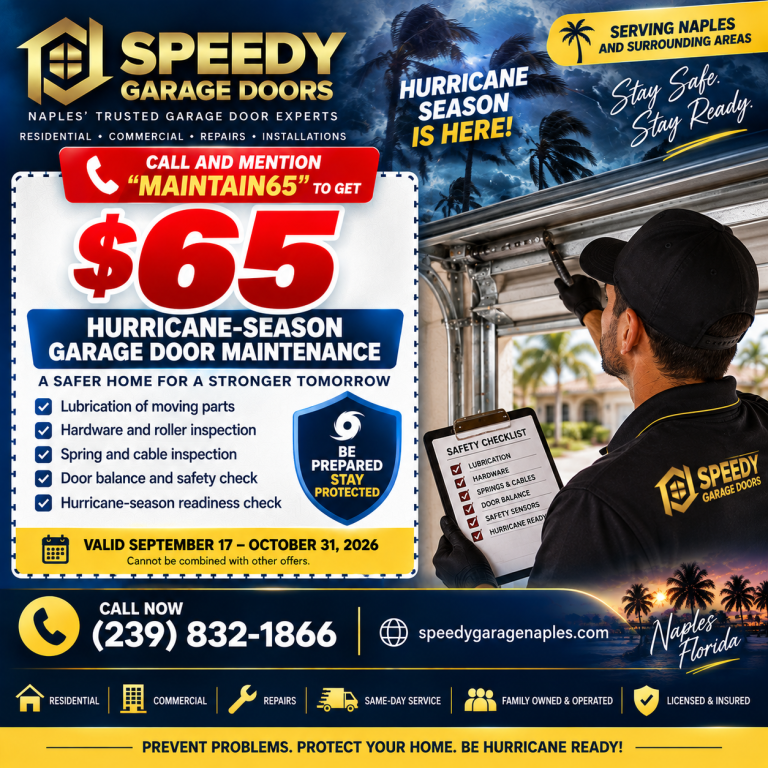
Lubrication, spring & cable inspection, balance and safety check, storm-readiness check — all for $65.
Call and mention MAINTAIN65
Valid Sep 17 – Oct 31, 2026 · Cannot be combined with other offers
This is a structural argument rather than a scare tactic, and once you follow it the priority list for your own house reorders itself.
Why this opening and not the windows
Look at a house from the street. Every other opening is comparatively small and framed on four sides by structure — a window is maybe fifteen square feet, a front door around twenty. A standard two-car garage door is roughly 112 square feet of thin, hinged, sectional panel covering a hole in a load-bearing wall. It has to stay light enough for a half-horsepower motor to lift, which puts a hard ceiling on how much material can go into it.
Wind does not simply push on that panel either. During a storm the pressure across it swings violently: positive pressure on the windward face as the gust front arrives, then negative pressure — suction — as the flow reverses. A door that survives the push can be pulled off its tracks twenty minutes later. That is why rated doors are tested in cycles rather than under a single load, and why “it feels solid” tells you nothing useful.
The arithmetic on a standard door
At the design wind speeds used along this part of the coast, the design pressure acting on a residential garage door commonly lands somewhere in the range of roughly 30 to 55 pounds per square foot, depending on exposure, building height, door size and where the door sits relative to a building corner. Take a conservative figure on a 16-by-7 door:
- 16 × 7 = 112 square feet
- 112 sq ft × 40 psf = 4,480 pounds
- Roughly the weight of a loaded pickup — applied and released, repeatedly, for hours
A builder-grade door with two horizontal struts and four track brackets per side was never engineered for that. It fails at the middle sections first, bowing inward until the ends of the stiles pull free of the rollers, and then the assembly folds into the garage.

What happens in the next thirty seconds
This is the part that turns a two-thousand-dollar problem into a two-hundred-thousand-dollar one. The moment the door goes, the garage becomes a pressurised box. Wind that was flowing around the house is now flowing into it, and the only way out is up. Internal pressure pushes on the underside of the roof deck at the same moment external suction pulls on the top of it. The two loads add. Trusses lift, the deck peels, and once the roof is compromised the interior walls lose their bracing.
It is the reason the Florida Building Code treats a garage door as a structural component of the building envelope rather than as trim, and the reason wind mitigation inspectors ask about it specifically.
Not sure whether your door is rated? We will look, free.
Speedy Garage Doors Naples — open 24 hours, 4.9★ from 336 Google reviews, locally owned, serving Collier and Lee County with 20+ years in the trade. Call (239) 832-1866 or message us on WhatsApp.
The checklist, in the order that matters
1. Find out what you actually have
Open the door most of the way and look at the inside face of the end stile — the vertical metal edge of a section — and at the jamb beside the track. A rated door carries a permanent label listing the manufacturer, model, the design pressures and a Florida product approval number. Photograph it and keep the photo somewhere you can find it. If there is no label anywhere, treat the door as unrated, because an inspector will.
2. Count the hardware
Struts are the horizontal reinforcing bars across the inside of each section. A standard non-rated 16-foot door often has one strut on the top section and nothing else; a properly rated door in a high-wind zone typically has one on every section, noticeably heavier. Then follow the vertical track from the floor and count the brackets attaching it to the jamb. Four per side is builder-grade. Rated installations commonly run eight or more, spaced exactly as the approval document specifies.
3. Push on the jamb
This is the check that fails houses. Press the wood where each bracket lands. If it is soft, spongy or split around the lag, or if the fasteners are short screws driven into a thin trim board, the door’s rating is meaningless — the connection will let go long before the panel does. In older Collier County homes, termite and moisture damage to the wood buck is extremely common and completely invisible from outside.
4. Understand what your address actually requires
Wind criteria are read by address, not by county. Design wind speed changes as you move toward the coast, and your building’s exposure category — how much open terrain or open water sits upwind of it — changes the pressures again. A door that is perfectly compliant in a wooded inland subdivision may be nowhere near sufficient on a waterfront lot a few miles away. Our page on wind load requirements in Collier County works through how a wind speed becomes a design pressure and exactly what an inspector checks.
5. Decide between rating and shutters — honestly
In a windborne debris region the opening has to be protected either by an impact-rated assembly or by approved shutters over a wind-load-rated door. Both can be code-compliant. The practical difference is that an impact-rated door requires nothing of you when a storm is named, while shutters require you to be in the state, physically able, and organised enough to deploy a panel system across the largest opening in the house. Seasonal residents in particular should think hard about that. The options and real installed costs are laid out on our impact-rated hurricane garage doors page.
6. Do the boring maintenance in May, not in September
A door you cannot open or close is a liability when you need to move a vehicle. Springs are rated in cycles rather than years, and a family using the garage as its main entrance burns through a standard spring’s life in three to seven years. Cables corrode. Rollers seize. None of that is expensive to address in the off-season and all of it becomes an emergency at exactly the wrong moment.

Three things not to do
- Do not crack the door “to equalise pressure.” This circulates every single season and it is wrong. A partly open door catches wind underneath and lifts. Close it fully and leave it closed.
- Do not buy a bracing kit at 6pm the night before. Retrofit vertical bracing genuinely helps against mid-panel bowing, but only when the floor bracket is anchored into the slab and the top connection reaches real structure. Installed in the dark into drywall, it does nothing at all.
- Do not force a damaged door open afterwards. A bent track will destroy the panels, the rollers and often the motor in a single cycle. If a storm has already done its work, the sequence is photograph everything, touch nothing, and call someone who handles storm damage repair and can document it for an adjuster.
The insurance angle most people miss
A permitted, inspected, rated garage door installation is one of the items a wind mitigation inspection looks at, and it can affect your premium. The critical word is permitted. An unpermitted install of a perfectly good rated door frequently earns nothing, because the credit is applied on the basis of the inspection report rather than on what is physically hanging there. That permit fee is the cheapest part of the job and the part that pays you back.
The uncomfortable summary
Most homeowners spend more protecting windows than protecting an opening five times larger, because windows are what the advertising talks about. If your budget this year covers one envelope upgrade, and your garage door has no label on the jamb, the door is almost certainly the higher-value place to spend it.
The cheapest hurricane garage door anyone ever buys is the one ordered in February. Once a system has a name, manufacturing lead times stretch, installers book solid, and the decision gets made for you.
Frequently asked questions
How do I know if my garage door is hurricane rated?
Open the door most of the way and look at the inside face of the end stile and at the jamb beside the track. A rated door carries a permanent label with the manufacturer, model, certified design pressures and a Florida product approval number. Photograph it and keep it. No label anywhere means the door will be treated as unrated.
What wind pressure does my door need to resist in Collier County?
It depends on your specific address, not the county. Design wind speed changes as you move toward the coast, and your exposure category changes the pressure again. For most residential doors here the required design pressure lands somewhere around 30 to 55 psf. We can look up the criteria for your address before you order anything.
Can I reinforce my existing garage door instead of replacing it?
Retrofit vertical bracing helps against mid-panel bowing when it is anchored into the slab and up to real structure. It does not convert an unrated door into a rated one, and it does nothing for a weak jamb connection. Treat it as a mitigation, not as a compliance path.
Should I leave the garage door open a little during a hurricane?
No. This advice circulates every season and it is wrong. A partly open door catches wind underneath and lifts. Close it fully and leave it closed.
Will a rated garage door lower my insurance?
It can, through the wind mitigation credit — but only when the installation was permitted and inspected, because the credit is applied from the inspection report. An unpermitted install of a good rated door often earns nothing.
How long does it take to get an impact-rated door?
Two to eight weeks depending on size, colour and the required design pressure, and lead times stretch sharply once a system is named. Order in the off-season — that is the difference between choosing your door and taking whatever is in stock.
Want the design pressure for your actual address?
Speedy Garage Doors Naples — open 24 hours, 4.9★ from 336 Google reviews, locally owned, serving Collier and Lee County with 20+ years in the trade. Call (239) 832-1866 or message us on WhatsApp.


